// BarryBlog //

A creative dumping ground for issues that interest me personally and professionally, with the thought they may interest you too. Issues such as the business of design, the design of business, the design of objects, design strategy, creative direction, innovation, creativity, thought leadership, observations, as well as recommendations, mid-century modern decorative arts and architecture, and the state of my thinking (and currently the state of my heart).

Wednesday, December 06, 2006

Thoughts on Design

“Tell me what and I'll show you how." —Barry A. Smith, Recently

“Design is so critical it should be on the agenda of every meeting in every single department.” —Tom Peters, 2003

“I simply believe that design, per se, is the principal reason for emotional attachment (or detachment!) relative to a product or service or experience or brand proposition. Design, as I see it, is arguably the number one determinant of whether a product-service-experience brand proposition stands out ... or doesn’t; has integrity... or doesn’t; connects ... or doesn’t. Furthermore, it’s ‘one of those things’ that few companies put – consistently – on the front burner.”
—Tom Peters, 2004

“Design is not just what it looks like and feels like. Design is how it works.” —Steve Jobs, 2003

“Design is hugely underrated as a strategic tool. Design is the essence of emotional attachment to a product or service or experience... and therefore the wellspring of the corporate culture (or ‘soul’) and of the brand proposition itself.”
—Tom Peters, 2004

“Beauty and brains, pleasure and usability — they should go hand in hand.” —Donald Norman, 2003

“The perfection of art is to conceal art.” —Quintilian, 95

“We require from buildings two kinds of goodness: first, the doing their practical duty well: then that they be graceful and pleasing in doing it.” —John Ruskin, 1880

“Design is a plan for arranging elements in such a way as best to accomplish a particular purpose” —Charles Eames

“To design is to communicate clearly by whatever means you can control or master” —Milton Glaser

“Design is directed toward human beings. To design is to solve human problems by identifying them and executing the best solution.” —Ivan Chermayeff

“Design is the art of gradually applying constraints until only one solution remains.” —Unknown

“The greatest challenge to any thinker is stating the problem in a way that will allow a solution.”
—Bertrand Russell

“Interactive design [is] a seamless blend of graphic arts, technology, and psychology.” —Brad Wieners, 2002

“[Leonardo Da Vinci] combined art and science and aesthetics and engineering, that kind of unity is needed once again.” —Ben Shneiderman, 2002

“True interactivity is not about clicking on icons or downloading files, it’s about encouraging communication.” —Ed Scholssberg, 2002

“To dismiss front-end design as mere ‘icing’ is to jeopardize the success of any site.” —Curt Cloninger, 2001

“Good designers can create normalcy out of chaos; they can clearly communicate ideas through the organizing and manipulating of words and pictures.” —Jeffery Veen, 2000

“The ability to simplify means to eliminate the unnecessary so that the necessary may speak.” —Hans Hofmann

“Visual appearance is one of the most effective variables for quickly differentiating one application from another.” —Bob Baxley, 2003

“I’ve been amazed at how often those outside the discipline of design assume that what designers do is decoration. Good design is problem solving.” —Jeffery Veen, 2000

“Like all forms of design, visual design is about problem solving, not about personal preference or unsupported opinion.” —Bob Baxley, 2003

“Making the simple complicated is commonplace; making the complicated simple, awesomely simple, that's creativity.” —Charles Mingus

“The architect should strive continually to simplify; the ensemble of the rooms should then be carefully considered that comfort and utility may go hand in hand with beauty.” —Frank Lloyd Wright, 1908

“The design of good houses requires an understanding of both the construction materials and the behavior of real humans.” —Peter Morville, 2002

“Form follows function-that has been misunderstood. Form and function should be one, joined in a spiritual union.” —Frank Lloyd Wright

“The details are not the details. They make the design.” —Charles Eames

“Questions about whether design is necessary or affordable are quite beside the point: design is inevitable. The alternative to good design is bad design, not no design at all.” —Douglas Martin, 1989

“Science arose from poetry… when times change the two can meet again on a higher level as friends.” —Johann Goethe

“…effective communication is a key factor in the success of your product.” —Jesse James Garrett, 2002

“Problems with visual design can turn users off so quickly that they never discover all the smart choices you made with navigation or interaction design.” —Jesse James Garrett, 2002

“Good design is the most important way to differentiate ourselves from our competitors.” —Samsung CEO Yun Jong Yong, 2004

“Design is the easiest way to reenergize a product.” —Fast Company, 2005

“Where you innovate, how you innovate, and what you innovate are design problems.” —Tim Brown, 2005

“Your products run for election every day and good design is critical to winning the campaign.” —Procter & Gamble CEO A.G. Lafley, 2005

“Design's fundamental role is problem solver” —Fast Company, 2005

“When people talk about innovation in this decade, they really mean design” —Bruce Nussbaum, 2005

“Design is the fundamental soul of a human-made creation that ends up expressing itself in successive outer layers of the product or service.” —Steve Jobs, 2005

“Innovation distinguishes between a leader and a follower.” —Steve Jobs, 2005

“You can't just ask customers what they want and then try to give that to them. By the time you get it built, they'll want something new.” —Steve Jobs, 2005

“I prefer design by experts - by people who know what they are doing” —Don Norman, 2005

“The commonality between science and art is in trying to see profoundly - to develop strategies of seeing and showing.” —Edward Tufte, 2005

“Design can be art. Design can be aesthetics. Design is so simple, that's why it is so complicated.” —Paul Rand, 1997

“Simplicity is not the goal. It is the by-product of a good idea and modest expectations.” —Paul Rand, 1997

“Simple design, intense content.” —Edward Tufte, 2004

“A designer knows he has achieved perfection not when there is nothing left to add, but when there is nothing left to take away.” —Antoine De Saint-Exupery

“Truly elegant design incorporates top-notch functionality into a simple, uncluttered form.” —David Lewis, 2006

“When you take technology and mix it with art, you always come up with something innovative.” —Robert Rodriguez, 2006

“An enterprise's most vital assets lie in its design and other creative capabilities.” —Samsung chairman Kun-Hee Lee, 2006

“Business success is always defined by the quality of the overall customer experience.” —Forrester Research, 2001

“Websites that are hard to use frustrate customers, forfeit revenue and erode brands.” —Forrester Research, 1998

“It's all about one thing: creative problem-solving to get the story out.” —Robert Greenberg, R/GA, 2006

“The challenge is about taking things that are infinitely complex and making them simpler and more understandable.” —Robert Greenberg, R/GA, 2006

“The product is the brand. You build brand in our industry through the product and the experience.” —Jim Wicks, Motorola, 2006

“Design is always about synthesis -synthesis of market needs, technology trends, and business needs.” —Jim Wicks, Motorola, 2006

“It's really hard to design products by focus groups. A lot of times, people don't know what they want until you show it to them.” —Steve Jobs, 1998

( via lukew )

Monday, December 15, 2008

Neocon and The Big Three

: : : : : : : : : : : : R_E_P_O_S_T : : : : : :: : : : : :

Ugh...Ford, General Motors and Chrysler are kinda IN THE NEWS lately, so for those who never heard my perspective on this, here it is (again).


( Begin original post from June 11, 2008 )

So I'm in Chicago at NEOCON 2008. Everywhere I look, I'm amazed. And it made me think. People are genuinely friendly, knowledgeable, and seemingly happy to see me as I walk into their space. I'm not asked if I'm "looking for something special." I'm not immediately apprised of sale items. I am not even asked for my email. Well in a couple I am.

All that said, "The Big Three" come to mind. Ford, General Motors and Chrysler. But also the Furniture Big Three– Herman Miller, Steelcase and Haworth.

These Big Three couldn't be more different.

I'm reminded of how amazing the contract furniture market is. It is so obvious that the Furniture Three see design as THE product they sell. They are selling experience and story. Unlike Pontiac's Driving Excitement®– the Furniture Three are genuinely excited and passionate about furniture. So much so that talking to them about it is more like going to lunch with a friend than arm wrestling a car salesman would be.


The thought that keeps coming to mind is how amazing it might be if the Auto Big Three would begin to be more like the Furniture Three. As I shared before here. Even though we find ourselves in tough economic times, it is apparent the Furniture Three have not cut back. Yes, there was noticably way less printed brochures and flashy food, but the commitment to design quality seemed to have been taken up a notch. Everywhere I looked, I was blown away by the thinking, the execution, and the delivery of the products they were just then bringing to market. It was an amazing showcase of design ingenuity and commitment to high design.


I realize I have been picking on The Auto Big Three unmercifully here, some of which is unfair generalization, but the point of all this jabber is to point out one thing.


Those who see design as a function and process will lose. Those who see design as core to what they do, how they do it, what they sell, and who they are, will win.


If the automakers saw the world through the lens of design, and by design I don't mean this year's body-style, then I would likely be driving one of their products. Instead, I buy the product that promises me an experience, that I see as relevant, and that I want to see succeed.


NEOCON is amazing. It is a tangible example of why the furniture industry is a leader in so many ways. Design thinking, business strategy and marketing communication, product innovation, environmental impact, sustainability, and so much more. I maintain that the best marketing is simply doing business well, consistently and with integrity, and with the understanding that nobody cares about your marketing as much as you. Herman Miller gets this. As does Steelcase and Haworth. And each of these three companies, although they are part of a struggling economy like everyone else, rise above the rest and are able to ask a premium for their products. A fact that when you attend NEOCON you will begin to understand why this is no big mystery. It's truly a cradle to cradle way of thinking. A renewable enterprise.

Labels: , , , , , , , , , , , ,

Tuesday, May 27, 2008

Interesting To Me: Allsteel Acuity Chair

BarryBlog posts on ideas, issues and objects that are really all over the map. This is a reflection of who I am as a thinker, a designer, a christian, and is how I originally envisioned the blog from day one. I post on things which have caught my attention and which I find interesting and at times important. Things I observe by intention, by happenstance, by referral, or by The Spirit, as a way and a place to file interesting things away for future consideration. And for you too, if you find them interesting. The feedback I get in these regards has always been a high point of the process.

The last few months I've been posting less, but with more frequency regarding my flea market finds and the collection I am curating 50 cents at a time via St. Vincent DePaul, Goodwill and other local flea market haunts. Judging by my stats, this is less interesting to some, though ironically my core reader still remains rather solid. It is always fun to see which posts spike readership, but I never set out to gain a following or to boost readership. In fact my blog can best be summed up by a quote from Samuel Butler from The Way of All Flesh which I discovered in reading my book by Herman Miller called "Notes on Attention" by Ralph Caplan."


Butler says...

"The literacy instinct may be known by man's keeping a small notebook in his waistcoat pocket, onto which he jots down anything that strikes him, or any good thing that he hears said, or a reference he thinks will come in useful to him." (I would add: "Or to you").
One thing I never tire of and always find interesting is contract and residential furniture. Furniture industry insider I am not, but having grown up in Mid-Michigan in a small design boutique that was furnished predominately in Herman Miller, then calling Grand Rapids home for a few years as a communication designer, I have developed a passion for contract furniture. All furniture really. I always seem to find incredible furniture and decorative art finds at garage sale prices, which has only fueled by desire to learn more. Perhaps it's learning I enjoy mostly about furniture, not the finds themselves. Maybe that could be another blog post.

Anyway, what I really appreciate the most about the furniture design industry is the leadership role it has earned in the overall design landscape. Furniture design is approached holistically, and design is considered and relied upon at every level of thinking— from the board room to the retail floor. Those who have followed BarryBlog know the business of design is an issue that's been discussed here frequently.


All that to say, the new Allsteel Acuity chair has caught my attention. In a big way. Mainly because of all it isn't. It sits quietly and expectantly for it's user to draw near. In my estimation, the chair's personality takes on the personality of the user, not visa versa.
In some ways I see the Allsteel Acuity chair more representative of Audi than BMW, if you will. The Acuity does what it says, the Aeron says what it does.
You get the picture. Do understand I am a major Herman Miller fan, but like the Aeron, I see the Allsteel Acuity chair in a really small group of excellent products. Perhaps the reason this chair is so excellent, and has so little, is because of Bruce Fifield at Continuum. According to Allsteel's president Eugene Sung, Bruce is a relative newcomer to chair design. I have always been a relative newcomer to each industry I have designed for, and often find this to be a distinct advantage. Mainly because of so little preconception. But as always, you must have a client who trusts your intuition, instinct and voice. After seeing Continnum's previous work, I can see how this would not have been a stretch for Sung.

In reference to paying attention, and to all that this chair is not, here is a great quote by Ralph Caplan from the same publication On Attention I referenced earlier in this post...

"Pay attention so that people are free to attend to what they care about. Ironically, though, the freest societies invariably create environments that militate against attention. Visual pollution is harmful not just because it is ugly but because it is distractive. And therefore destructive. Like other pollution, it destroys the balance of nature–in this case, human nature. A climate loaded with designs clamoring for your attention is a climate in which you end up paying attention to nothing."
Bravo Eugene and Bruce and team. Thanks for paying attention. It made a connection. With me, anyway. And that's why it's on BarryBlog.

Labels: , , , , , , , , , , , , ,

Friday, September 18, 2009

Do you know what you want? Spielberg Does.

Incredibly easy for me to understand; not particularly easy to explain; and a complete lack of understanding (or a denial) by many businesses, are the myriad of reasons why senior design thinkers (Creative Directors, Art Directors, [not design stylists]) should be involved in the crafting of every day business, not just design. Spielberg says it best here. Knowing what you want is in large part the result of having spent years of your life imagining things from the inside out. Making things that are completely unrelated and intangible, that when connected in a new context, create a tangible whole. The supreme irony to the business bottom line is this: many people who can champion this often untapped business tool are themselves unable to picture it. The exact people who hold the purse strings literally don't see this potential, and by familiarity and lack of action relegate design to the important but marginalized business of aesthetics. As everyone looks to innovate, compete and pursue business in this new economy, I recommend looking close to home. As Spielberg says..."Can you see this?" For me, that's an easy answer. Vision is the ability to see. Seeing is the ability to think. And in companies wanting to prosper, top thinkers are given the chance to grow.

Labels: , , , , , ,

Wednesday, March 14, 2007

Big Picture Thinkers: 7 Secrets

Thinking big is an ability of mine. This can be annoying to many and an asset to others, but in either case is related to the way I was fearfully and wonderfully made. Fortunately for me, thinking big was modeled well and often in my career as a communication designer and strategist. The ability to think big first hit home in my early career as a result of the tutelage of Lauren Ciesa of the design firm of Ciesa & Associates in one of my formative design experiences in East Lansing Michigan. Lauren taught me what design can do for a companies' bottom line and the difference between strategy and decoration. Later, under the guidance of Jim Thomas of the JD Thomas Company, I learned how design and content were one. He taught me how to think big, and how great design thinkers are valued and compensated professionally as a result of the value this adds to a business model.

So being interested and involved as such, I came across an article which in theory shows how you might also become a better big picture thinker.

Here goes:

From CEOs to independent professionals to work at home moms, Big Picture Thinkers inspire others and lead the way in their fields. Without their insights and actions, our world would be lacking in innovation, new products, and fresh approaches.

Now there is a way for you to connect with your larger vision and see it through to success. You can bring out the creative thinker in you by following these seven success tips. Whatever direction you're headed, these strategies will help you move forward and make the most of your natural strengths and great ideas.

1. Catch your ideas
No matter how outrageous or silly, catch your ideas and revisit them from time to time. You might have a diamond in the rough that you can't yet see. Write it down, tell it to someone, draw a picture, pace the floor, use whatever technique helps you remember and develop your ideas, use it!

2. Understand your strengths
There is an old saying that goes something like this: Just because you CAN do something doesn't mean you SHOULD. A big challenge for creative people and entrepreneurs is concentrating your efforts on what comes easily and effortlessly. To pinpoint your strengths you can take a formal assessment, but I often ask clients to start with a simple question and jot down whatever comes to mind: If I could devote my life to serving others- and still have the money and lifestyle I need- what would I do? How would it look?

3. Avoid “overwhelm”
Overwhelm can be described as either having too much on your plate or PERCEIVING what you have to be too much. The first step to take is getting real with time management. If your time management skills are poor, then you will feel overwhelmed and it will zap your energy and your focus. Next, learn how to say "No." Accepting too many responsibilities will burn you out, blur your focus, and zap your big picture thinking gifts.

4. Listen
What do you hear people asking for? What are they NOT asking for? What are they griping about? Become a great listener in all your interactions. Ask open ended questions (ones that can't be answered with a yes or no). Keep your ear to the buzz and maybe you'll zero in on the next big thing.

5. Develop your intuition
Learn to trust your hunches and listen for inner nudges. Your next great idea may already be inside of you yearning to break free. Visionary thinkers often act on these hunches. Become best friends with your intuition and see new possibilities come to you.

6. Talk about your ideas
Create a personal board of directors: a supportive group of people who you respect, trust, and encourage you. Ask for their honest feedback, brainstorm with them, or call on them when you need help.

7. Give your mind time to wander
If you're sitting in front of a computer frustrated because a solution isn't presenting itself, then change your location. Take a walk. Get out and play. Get out and do something (anything!) other than what you SHOULD be doing. Studies show that the most creative, innovative thinkers are not slaves to the desk. They add variety to their lives and keep their minds sharp by enjoying all the gifts the world has to offer.

Big Picture Thinkers have the natural gift to see the potential in just about anything. When you sharpen your visionary skills, you too can enjoy success and joy in all aspects of life and business.

( via Nancy Marmolejo @ comadrecoaching )

Labels: , , , , , , ,

Wednesday, December 06, 2006

Biz-as-Usual and Biz-by-Design: Tough Love


Another great Fast Company article—this time by Roger Martin, dean of the Rotman B-school, on the three keys to making business and design work place well. Because business wants to love design, but it's often an awkward romance.

1. Reckoning the Future: Prove It or Invent It?
2. The World of Work: Permanent Tasks or Temporary Projects?

3. Source of Status: A Large Staff or an Outsize Success?


Managing the yin and yang of business-as-usual and business-by-design means striking a balance between any number of countervailing impulses: Give people the freedom to follow their nose, but hold them accountable for their performance. Set a high bar, but recognize that failure is an unavoidable consequence of pushing into new territory. Do everything possible not just to thrill your customers but also to wring costs and efficiencies out of vendors and suppliers. The biggest challenge for all of us, designers and business people alike, is to become equally adept at quantifying the now and intuiting what's next. There's simply no other way to win.

( Read MORE )

Wednesday, March 07, 2007

Business of Design: Business Upturn

According to Gordon Kaye, editor of GRAPHIC DESIGN USA newsletter | March 07, one of the dark little secrets that everyone who writes about design knows is that graphic designers tend to be pessimistic by temperment, and to downplay their successes and prospects in business. But the conventional wisdom is turned on its head by the upbeat findings of a Winter 2006-2007 survey by The Industry Measure.

Specifically: 78% of all creative professionals reported that business conditions are as good as or better than in the past 12 months. And the number who said business was poor or very bad fell a few percent.
Solid and positive all around, even a bit sunny. Not to worry, though. This was all before the recent stock market slide so, hey, relax; you can still find something to fret about if that makes you feel comfortable.

Fellow blogger and graphic designer Chris seems to mirror this finding in this recent post as well as this one regarding new work.

( via GDUSA Newsletter )

Labels: , , , , , , ,

Monday, November 15, 2010

Looking for a Senior Level Graphic Designer

UPDATE: No longer looking, and grateful to God for His timing.

Looking for a Needle in a Haystack was a post I wrote in 2008 as the company I work for was looking to bring on a new staffer. I post this today because we're once more looking to add a position. If you know someone who might be a solid candidate, send them here to read what I said then.

The teammate we're looking to add is a communication design thinker, who adds at a senior level. In the world of design, a title can mean different things depending on where you work. This position is called Senior Designer, but as I just suggested, in many independent agencies, this might also be called Art Director, or something else. Regardless of title, this candidate would possess strategic planning and execution skills and would be passionate about both the creative and business side of design. More specifically, the position requires swift and thoughtful design solutions for internal clients
(mostly), under the leadership of a senior art director (that would be me). The position and the opportunity is broad—and includes brainstorming projects with an impressive pool of fellow creatives, and at times clients; strategic and creative development; design execution of all your projects; and design presentations. In other words, this position has a ton of autonomy for the person with the right mix of thinking, communication ability and tact.

A couple other important things I like to point out is that we're looking for someone with what I call a "voice"—that is, someone who has an interesting perspective on how best to develop work that gets results. Someone who adds uniquely to a discussion. Also, someone who understands what it means to be a servant leader. That is, someone who cares about growing everyone around them. A servant leader grows trust and value within our company.

We work on Macs, and are getting all new ones this Friday (can you tell I'm excited).


All that to say, filling a position at Tyndale has always been challenging, so if you would pass this on to people you know who are truly at a senior level (not just people you like a whole lot, and would love to see get a job), I would very much appreciate it.

Labels: , , , , , , , ,

Saturday, March 31, 2007

Taxi Interviews: Heller, Sagmeister, Kidd

Another great Design Leader interview from Taxi, a design portal I've brought to your attention before, only under the name DesignTaxi. I can't tell if my former name for the site was in error, or whether they changed their name. Either way, this new interview features three heavyweights (skill not waist size) in the design profession: Steven Heller, Stefan Sagmeister and Chip Kidd. All in all a good three part interview. There are many other great interviews on the taxi Design Leader site, but I can't figure out how to make a link to them individually. Consequently if you are interested in any of those listed below, just go to the main site, and look at the bottom right under the category "EXCLUSIVE: Design Leaders" and click on the individual names there.

  • Neil French
  • Joanne Ooi
  • Duangrit Bunnag
  • Eikoh Hosoe (Japan)
  • Neil Leifer (USA)
  • Duane Michals (USA)
  • Michael Hockney, D&AD (Chief Executive)
  • Garry Blackburn & Simon Elliott, Rose (UK)
  • Christopher Liechty, AIGA Center for Cross-Cultural Design (President)
  • Jacques Lange, ICOGRADA (President)
  • Christopher Liechty, AIGA Center for Cross-Cultural Design (President)
  • Darrel Rhea, Cheskin (USA)
  • Sara Little Turnbull, Stanford Graduate School of Business (USA)
  • Adelia Borges, Museu da Casa Brasileira (Brasil)
  • Linda Fu, Linda Fu Design + Global iCome Consulting (Australia)
  • Esen Karol, Esen Karol Design Ltd (Turkey)
  • Mervyn Kurlansky, Mervyn Kurlansky Design (Denmark)
  • Saki Mafundikwa, Zimbabwe Institute of Vigital Arts (Zimbabwe)
  • Ravi Naidoo, Design Indaba + Interactive Africa (South Africa)
  • Sanja Rocco, ROCCO&PARTNER (Croatia)
  • Henry Steiner, Steiner&Co (Hong Kong)
  • Omar Vulpinari, Fabrica (Italy)
  • Tarek Atrissi, Tarek Atrissi Design (Netherlands)
  • Sean Bolan, University of Washington (USA)
  • Cristina Chiappini, Graphic and Interactive Design (Italy)
  • Halim Choueiry, Virginia Commonwealth University (Qatar)
  • Lorraine Gauthier, Work Worth Doing (Canada)
  • Andrea Marks, Oregon State University (USA)
  • Alejandro Quinto, Work Worth Doing (Canada)
  • Chang Sik Kim, San Jose State University (South Korea)
  • Maurice Woods , Achana (USA)
  • Henk van Assen, Yale University School of Art (USA)
( via Quipsologies )

Labels: , , , , , , , ,

Thursday, April 10, 2008

Modernism101. All the books you've never seen.

Everyone's heard of Rare Air. Well in my estimation, Randall Ross is the Michael Jordan of the Rare Book world. Simply put, his Modernism101 store has the most, and the best jaw dropping rare publications on the business and art of design. Word has it the boys at Grain Edit have some gems too but I can't find where. Randall's breadth and depth of products are amazing. Take for instance the Alexey Brodovitch Portfolio Magazine complete set he has available at the time of this post (or not if this post is old). Don't be shocked at the price. I have seen them for more. But the point is you don't see this stuff come up to auction much.

Since I was about 20, I have been a fan of
Brodovitch, Paul Rand, Lester Beal, George Nelson, John Massey, Wim Crouwel and others. Randall either has or has had books by and about these designers as well as nearly everyone and everything else imaginable.

Frankly, he has every rare book you've never seen.
He also does a remarkable job describing the books. You can get a design education reading through his descriptions. This is a big plus to his store in my estimation. He describes his store as:
... an excellent and ever-changing selection of rare and out-of-print design books and periodicals covering all aspects of 20th-century visual culture. I specialize in the areas of Graphic Design, Architecture, Interior and Industrial Design, and Photography
Go to Modernism101 now. You never know what you'll find.

Labels: , , , , , , , , , , , , ,

Wednesday, May 09, 2007

Motorola RAZR: Bad Design is Bad Business

According to a recent article by Business Week's Bruce Nussbaum regarding Motorola's RAZR phone, bad design is bad business. According to Nussbaum this is an indicator of the understanding or misunderstanding of design by senior managers of companies. Design is more than style, more than a fashion statement. If the product's promise can't deliver, your product/service will ultimately annoy the heck out of your consumers. And you will pay. Read the rest of the article here.

( via
NussbaumOnDesign blog )

Labels: , , , , , , , , ,

Monday, January 08, 2007

My Testimony: Gettin' All Transparent

You've probably figured out by now that BarryBlog is an odd collection of things I find of interest— with the hope you will enjoy them too. Things such as communication design, the business and value of design, thought leadership, books and book design, publishing, well designed products and services, ideas, and at times faith (to name a few). And since it's always been about my passion for sharing, and about being transparent, I can't get more transparent than this post.


powered by ODEO
To be frank, I've had this post prepared and archived since the inception of BarryBlog. But as you'll see, it's not something to just "spring on someone" right out of the gates. But with 6 months under my belt, and a fresh year upon us, I've decided to pull the trigger.

My testimony is a humble record of the work that's been done in my heart through the redemptive grace of the Spirit of God. You can count on the fact that like myself, it sounds broken, unpolished, and incomplete. But I've been given a gift of salvation which is simply hard to explain—is something that took me 35+ years to fully understand and accept—and something I no longer care to keep to myself. And though broken and incomplete, my hope is that someone might be encouraged by my sharing.

I post my chapel testimony podcast with the understanding that should you find the Christian message offensive, you'll choose not to listen. And I trust that if you've enjoyed anything about BarryBlog in the past, you should have no reason not to enjoy more of the same in the future.

Some will say sharing this took courage. Others may find it inappropriate, too out of context, or of no interest. Should you decide to set aside time to listen, you'll get a look into my very personal story. And believe me, it's not the best story you've ever heard. But I thank God it's mine.


( Listen using iTunes. )

Labels:

You Down with BBD?: Yeah, you know me!


Previously in BarryBlog I've discussed the outstanding DesignCouncil – Canada's equivalent to our own AIGA. I recommend their great site to anyone hungry for design insight, rationale, research, education and inspiration.

The main reason for this post however is to share a site with you that I've been frequenting – the Better by Design organization, or BBD – a government funded group which aim is to help New Zealand companies increase their business bottom line through the better use of design in their products and services.

Better by Design is an awesome site. Like DesignCouncil, BBD is New Zealand's authority on design value and innovation. Now don't get me wrong– I appreciate my membership in the AIGA greatly, even more so as I consider it's primarily volunteer base, but man what a little federal government funding does to make a professional design organization top of mind to the business community as a whole. Bravo to BBD.

Tuesday, December 16, 2008

George Nelson Exhibition at Vitra Design Museum

Anyone who reads my blog with any frequency knows I am a Herman Miller and specifically George Nelson admirer. In fact as I watched this video, I felt a real connection with him for the way he thinks, and his passion for the integration of design into all areas of business. He was a lifetime educator in and out of the classroom. He was a leading writer on design. He was also a designer. And an architect. And to me the most value he added to the world at large was his abilities as a thought leader. He was so ahead of his time. I suspect part of what made him successful was Herman Miller's leadership and their desire to have someone of his caliper involved in the decisions of the company. The rest of his success I'm sure can be chalked up to vision, passion, intensity, and a spirit to innovate that I bet was really contagious. Hope you enjoy this video as much as I have.


( via whatwedoissecret )

Labels: , , , , , , , , , , , ,

Wednesday, October 10, 2007

Fast Company: 2007 Masters of Design

Innovation and inspiration. Beauty and profit. Management and creativity. Fast Company October 2007 reports on the intersection of business and design. The online version has multimedia and a ton of things the print version does not (and visa versa, I know, as I finally broke down and subscribed). You can also find archives for years 2004, 2005 and 2006. Masters feature Yves Behar, Bob Greenberg, Sam Lucente (my favorite), Paola Antonelli and Philippe Starck. The website also includes resources, green design, elements of design and a newcomers section. What are you waiting for? Now get yer learnin' on.

( via Cameron Moll's Premium Linkage )

Labels: , , , , , , , , , , ,

Thursday, August 28, 2008

Coke Inhouse Design: Talking Design to Non-Designers

Coca-Cola's design chief David Butler was told 5-years ago: "We need to do more with design. Go figure it out." Butler describes how he has learned the most effective way to implement design strategy at a company as large and complex as Coca-Cola: avoid the word "design" as much as possible.

What a great article to help insider's speak the language of design in a language business will understand.

( via Business Week Insider )

Labels: , , , , , ,

Friday, February 02, 2007

Innovation and Strategy - Who Manages Manufacturing?

REPOST: I wrote this article a while back, I still find it interesting so I'm reposting it. Sue me.

Through 18 years of professional design experience and from cumulative observation, I’ve discovered a key to finding success in design innovation often lies in looking at and engaging in less-mined and less typical resources. Some of the best brainstorming meetings I’ve been responsible for or party to have included
unusual subjects. Such as a warehouse worker. A project manager. Someone in editorial. Anyone less exposed to the day to day creative process.

There are many reasons for this. More than I can discuss here (more than you would be interested in reading about), but most importantly more reasons than I am
smart enough to understand. But what I do understand is that design innovation is not particularly formulamatic like some engineering tasks and related design sciences.

Anyway...
...so when I came across this article on the subject of Manufacturing teams, and how some farsighted companies are beginning to understand the value of giving manufacturing teams greater visibility and respect in strategic leadership, I took notice. Told using the analogy of manufacturing as the engine in a ship, this article gives weight to how critical manufacturing is to the success (or failure) of adopting a successful design innovation engine.

( via strategy+business - Illustration by Leigh Wells)

Friday, March 12, 2010

D. J. De Pree - Herman Miller Millwright Story

Beginning fall 2006, BarryBlog was once vibrant and daily, but now rather sleepy and sporadic. But if you look through the archives or Google Search Herman Miller and BarryBlog, chances are you'll find the many times I've spoken of the great company Herman Miller. I've gained a deep appreciation since I first experienced the performance and aesthetic of their wares at a small design firm in East Lansing Michigan, right out of college. The owner of that shop bought only Herman Miller, and I have been hooked since. Then while working as a senior art director in a small Grand Rapids marketing communications consultancy, I had further opportunities to learn about the company. While in Grand Rapids, I spent hours at their refurbished product store which at the time was called REMARK. I so miss that great store.

In the must read "The Design of Herman MIller", by my hands down favorite writer, Ralph Caplan, I learned how
D. J. De Pree founded the company based on his Biblical worldview. As I read that, it was easy to compare with the current company who employs me, Tyndale House Publishers. Like D. J., Ken Taylor built a company with people as a priority. Like D. J., Ken realized how important people are to the overall day to day success of the business.

So tonight while I was further researching Herman Miller, I came across this wonderful example of how D. J. approached business, and more specifically, the people who worked for him.

Someday I would love to help grow Herman Miller using my God given skills. Like Tyndale, they are one of the few great companies left.

See for yourself, in D. J. De Pree's own words.


Labels: , , , , ,

Thursday, December 14, 2006

Chronicle Books: Redesign "Plus"


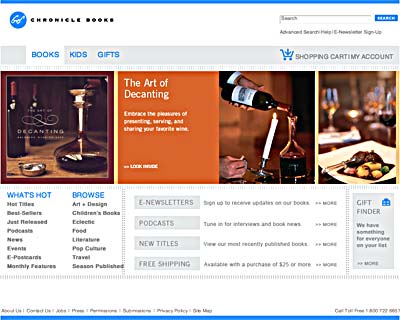
Not sure if this is still considered "news" or not, but...I've seen Chronicle Books web redesigns before (1, 2), but this one I found as a result of visiting my RSS subscription to Cameron Moll's Premium Linkage where he shows they're offering 40% off all books, ugh... well... until December 10th... (sigh).

Anyway, the Chronicle Books (new?) website couldn't be easier to use, and when you consider the nature of Chronicle product, one might expect visual eye candy. Instead, they've opted for understatement and usability. I especially appreciate their Podcast section, which features exclusive author interviews, man-on-the-street commentary, and tidbits on various topics.

For me, what differentiates Chronicle Books website from other book publisher websites is the fact that there is information and interest beyond pure utilitarian purpose. Like a print catalog that just shows product, more relevance is required if a publisher ever expects the audience to engage in any valuable way beyond "Business as usual." "Business by Design" is a more intentional and engaging enterprise. Just by adding editorial interest (story) in the form of Podcasts, Chronicle has given me a reason to come back. Plus, if I enjoy the editorial bend of the podcasts, it might leave a favorable impression on me. And as everyone knows (right?), Chronicle's brand value is really the sum of what other's believe it to be, not the other way around.

I've always believed in imparting personality into every project I develop on behalf of my employer, as a way to add business value and to build continuity with every effort.
The new Chronicle website does just that. It's makes the sales person happy as a utilitarian sales tool, and it serves a larger goal of leaving a favorable impression on me. Combined, the website has a personaility. A personality that to me just wouldn't be as interesting, appealing and memorable if it were "just a website."

So
excuse me, I'm going to go back to their site and listen to another podcast... or buy one of their books.


( via Cameron Moll - Authentic Boredom )

Wednesday, September 20, 2006

Innovation isn't business as usual


Companies who’s boardroom understands the tangible value of design and brand also understand creativity and innovation requires a unique blend of work and play. And only a few companies in the world are as successful in these regards as Apple. Jonathan Ive, Apple’s creative thought leader and senior vice president of product design, leads a team with the utmost respect and concern for the design process. Here’s a rare glimpse into Apple’s design and innovation process under Ive’s stellar leadership.

Still Interested? Then check out...

More lessons on Design Innovation

BusinessWeek Innovation


( thanks Chris A )

Labels:

Older Posts